
Cosmic ray-driven electron-induced reactions do not explain global ozone depletion!
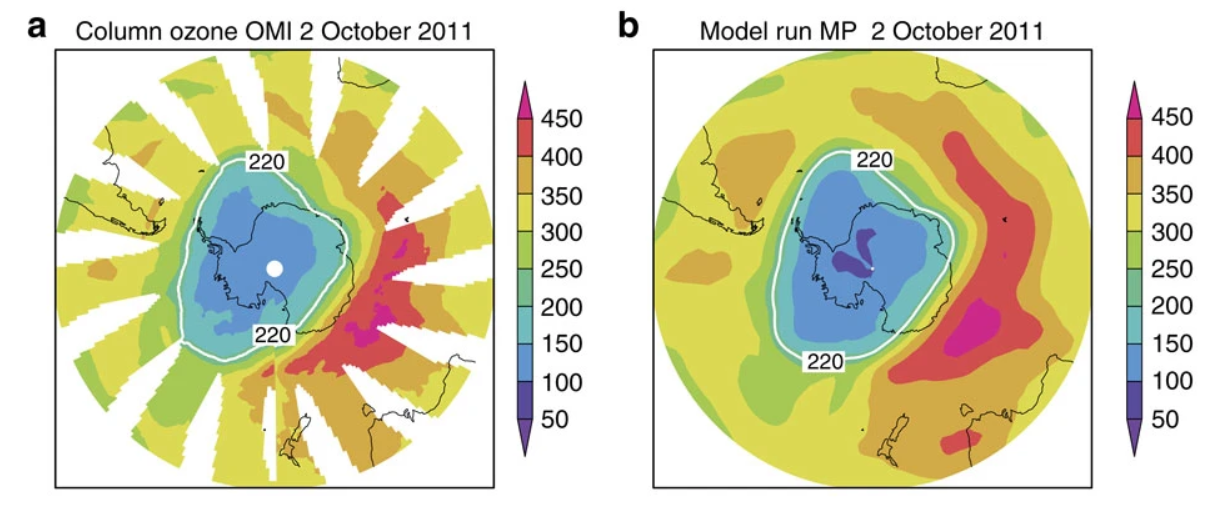
Actually, this should not qualify as 'news' at all. The past observed depletion of stratospheric ozone has been studied extensively and is generally explained quantitatively by well understood chemical and dynamical processes. For example, the Antarctic ozone hole is caused by chlorine (and bromine) chemistry and interactions with polar stratospheric clouds (e.g. see above image comparing TOMCAT and satellite observations from Chipperfield et al., doi:10.1038/ncomms8233, 2015).
Anyway, the many thousands of papers on this topic did not prevent the journal Proceedings of the National Academy of Sciences (PNAS) from recently publishing a couple of papers which ignored this huge body of work and suggested global ozone depletion could be solely, completely and perfectly explained by cosmic rays and their interactions with halogen source gases...
We have written a rebuttal of these papers which is now published in PNAS. Please read this for more information.
Godin-Beekman, S., M.P. Chipperfield, R. Mueller, J.L. Neu, P.A. Newman, M.L. Santee, S. Solomon, D. Tarasick, A.M. Thomson, Z. Wang, Cosmic ray-driven electron-induced reaction theory does not explain spatiotemporal variations in stratospheric ozone and temperature, Proc. Natl. Acad. Sci. U.S.A., 123, doi:10.1073/pnas.2528723123, 2026.
A previous rebuttal on the same topic:
Chipperfield, M.P., A. Chrysanthou, R. Damadeo, M. Dameris, S.S. Dhomse, V. Fioletov, S.M. Frith, S. Godin-Beekmann, B. Hassler, J. Liu, R. Muller, I. Petropavlovskikh, M.L. Santee, R.M. Stauffer, D. Tarasick, A.M. Thompson, M. Weber and P.J. Young, Comment on "Observation of large and all-season ozone losses over the tropics" [AIP Advances 12 075006 (2022)]
AIP Advances, 12, 129102, doi:10.1063/5.0121723, 2022.