
Moorland burning and impact on air pollution
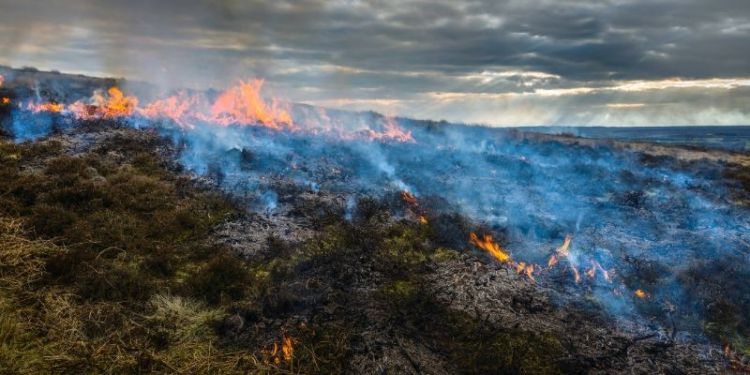
Managed burning on moorland in the UK led to millions of people being exposed to unsafe levels of fine particulate pollution, according to research led by Ailish Graham and the Royal Society for the Protection of Birds (RSPB).
Prescribed burning is traditionally used to manage heather for grouse shooting across the UK uplands. Until recently it was not possible to map where is burned each year because the burn patches are very small. Ailish and co-workers used new high-resolution satellite images of burn scars from the RSPB to estimate fire emissions from the burning. Using a regional air quality model they quantified the impact of prescribed moorland burning on UK PM2.5 and found burning increases daily regional concentrations by 2-16%. This burning can expose up to 2.3 million people above World Health Organisation 24-hour PM2.5 limits.
The paper is published in Environmental Research Letters.
Graham, A.M., D.V. Spracklen, M.P. Shewring, D.J.T. Douglas, R.J. Pope and M.P. Chipperfield, Prescribed moorland burning in Great Britain exposes 2.3 million people to PM2.5 levels exceeding the WHO 24 h guideline limit, Environ. Res. Lett., 21, 104001, doi:10.1088/1748-9326/ae5de3, 2026.
University of Leeds news story
U. Leeds Biosphere Atmosphere Group