
Age of Air
The stratospheric mean age-of-air (AoA) is a measure of the time an air parcel has taken to circulate in the stratosphere. AoA has become a very important and sensitive metric for quantifying the speed of the slow stratospheric Brewer-Dobson circulation. TOMCAT-related work has used AoA metrics to test different versions of the model, improve the quality of meteorological reanalyses and reveal important multiannual variability in stratospheric dynamics.
Testing Models
Simulations with early versions of the TOMCAT CTM (with vertical motion diagnosed from divergence of the horizontal winds) produced a circulation which was much too fast – easily diagnosed as too-young age-of-air. This lead to the development of the novel SLIMCAT version of the model with isentropic levels in the stratosphere and vertical transport calculated from diabatic heating rates. Chipperfield (2006) discussed different versions of the model and made use of AoA to show the improved performance of SLIMCAT at the time.
Improving Meteorological Reanalyses
From a wider perspective, through the SLIMCAT work we saw how tracer modelling used to test models could be used to improve meteorological “re-analysis” datasets and greatly expand their user community. Our TOMCAT/SLIMCAT CTM could uniquely assess the accuracy of the slow stratospheric circulation in different test versions of the European Centre for Medium-Range Weather Forecasts (ECMWF) reanalysis products. The optimum version was adopted for the new ERA-Interim data (Dee et al., 2011), and introduced the chemical transport modelling community as significant stakeholders in services of operational weather centres.
AoA diagnostics provide a useful measure of the quality of reanalysed wind fields and, specifically, of their suitability for driving models of stratospheric chemical transport and stratosphere/troposphere exchange. The figure below, from the extremely highly cited paper by Dee et al. (2011), demonstrates the improvements achieved in ERA-Interim through TOMCAT/SLMCAT simulations. The curves represent estimates of mean AoA at 20 km altitude as a function of latitude, obtained with the model when using reanalysed winds from ERA-40 and ERA-Interim. Monge-Sanz et al. (2007) further discuss this diagnostic and how it is computed. The close match between the TOMCAT AoA estimates and those obtained from observations reflects the improved quality of the mean stratospheric circulation in ERA-Interim over previous datasets. Based on this improved representation of the Brewer-Dobson circulation, reanalyses such as ERA-Interim (and successor ERA5) are now widely used by transport modelling groups worldwide.
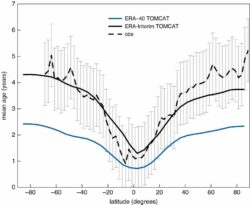
Mean age-of-air (years) at a height of 20 km, as a function of latitude, as determined from transport simulations with the TOMCAT model driven by winds from ERA-40 (solid blue) and ERA-Interim (solid black), in this case corresponding to the year 2000. Independent estimates from aircraft CO2 and SF6 are also shown (dashed black) with error bars (grey). From Dee et al. (2011).
Atmospheric Variability
Related to the above AoA discussion, TOMCAT work has made major contributions in assessing the effectiveness of the Montreal Protocol. Satellite and ground-based observations of increasing stratospheric HCl over an extended period from 2007 onwards appeared to contradict the expectation of decreasing chlorine, and were thus challenging from both a scientific and policy perspective. However, our work (Mahieu et al., 2014), making use of modelled AoA, showed that the increase in HCl was caused by atmospheric variability, which occurred over an unexpected multiyear timescale, confirming the Montreal Protocol was still on track.
TOMCAT References
Chipperfield, M.P., New version of the TOMCAT/SLIMCAT off-Line chemical transport model: Intercomparison of stratospheric tracer experiments, Q. J. Roy. Meteorol. Soc., 132, 1179-1203, doi:10.1256/qj.05.51, 2006.
Dee, D.P., Uppala, S.M., Simmons, et al., The ERA-Interim reanalysis: configuration and performance of the data assimilation system. Q. J. Roy. Meteorol. Soc.,137, 553–597. doi:10.1002/qj.828, 2011.
Mahieu, E., M.P. Chipperfield, J. Notholt, T. Reddmann, J. Anderson, P.F. Bernath, T. Blumenstock, M.T. Coffey, S. Dhomse, W. Feng, B. Franco, L. Froidevaux, D.W.T. Griffith, J. Hannigan, F. Hase, R. Hossaini, N.B. Jones, I. Morino, I. Murata, H. Nakajima, M. Palm, C. Paton-Walsh, J.M. Russell, M. Schneider, C. Servais, D. Smale and K.A. Walker, Recent northern hemisphere hydrogen chloride increase due to atmospheric circulation change, Nature, 515, 104-107, doi:10.1038/nature13857, 2014.
Monge-Sanz, B., M.P. Chipperfield, A. Simmons and S. Uppala, Mean age of air and transport in a CTM: Comparison of different ECMWF analyses, Geophys. Res. Lett., 34, L04801, doi:10.1029/2006GL028515, 2007.