
Solar - Climate Interactions
Changes in incoming solar irradiance due to varying solar activity play a significant role in climate forcing. The most substantial changes in solar irradiance occur at shorter wavelengths, particularly in the ultraviolet (UV) part of the solar spectrum. This is crucial because detecting and understanding related changes in stratospheric ozone is key to improving our understanding of solar-climate interactions.
During solar maximum (more solar activity and more sunspots), increased UV radiation enhances the photolysis of O2, leading to more ozone production. Conversely, at longer UV wavelengths, enhanced O3 photolysis results in net ozone loss. This “top-down” mechanism, where changes in solar irradiance primarily affect the upper atmosphere and then propagate downward, is important because these changes can significantly impact stratospheric ozone levels and, consequently, influence the climate. The impact of these variations can depend on the time period considered, as ‘11-year’ solar cycles can vary in strength and duration.
We use TOMCAT Chemical Transport Model (CTM) simulations to quantify changes in stratospheric ozone associated with changes in solar irradiance. We analyse ozone profile datasets from various satellite instruments (e.g., SAGE II, HALOE, MLS) to estimate the solar cycle signal in tandem with model-based estimates. Since TOMCAT is forced with meteorological reanalysis data (our best estimates of past weather), we can perform various sensitivity simulations using different solar flux datasets such as Naval Research Laboratory (NRL), SATIRE, and SORCE (satellite-based) to understand the effects of solar irradiance variability on ozone. These simulations allow us to analyse the chemical effects of time-varying solar fluxes. Simulations using fixed solar fluxes are analysed to quantify the effect of any implicit solar cycle signal (SCS) in reanalysis meteorological data.
Our various studies have redefined our understanding of the solar cycle signal (SCS). Previous studies suggested that changes in solar irradiance over the 11-year sunspot cycle cause a double-peak-structured SCS in tropical stratospheric ozone (peaks in the upper and lower stratosphere and minima in the middle stratosphere). However, our analysis (Dhomse et al., 2011; 2013) using updated data from SAGE II instruments showed that the upper stratospheric signal is much smaller, with the peak occurring at lower altitudes. These estimates are in good agreement with TOMCAT-derived estimates (e.g., Dhomse et al., 2016). Later, we also demonstrated that SCS estimates vary depending on the analysis period. For example, using recent 18-year data from the MLS satellite (2005-2020), we found that the SCS shows only a single peak in the middle stratosphere. The differences in the SCS observed by SAGE II and MLS may be due to the effects of volcanic eruptions and the non-linear changes in chlorine loading present during the SAGE II data period but not in the later MLS data (e.g., Dhomse et al., 2022).
Recently, we have been exploring different statistical methodologies to investigate various aspects of solar-ozone coupling in stratospheric ozone and temperatures (e.g., Li et al., 2023, Dhomse et al., 2022).
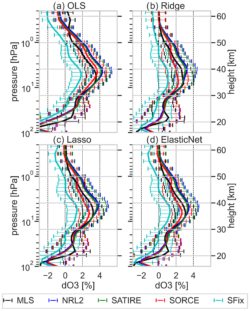
Figure: Solar cycle signal for 2005–2020 period (per 100 solar flux units) in tropical (20∘ N–20∘ S) stratospheric ozone profiles from the Microwave Limb Sounder (MLS) and four TOMCAT simulations (NRL, SATIRE, SORCE and Fixed solar fluxes) using four types of regression models (a) OLS, (b) lasso, (c) ridge and (d) elastic net. Horizontal lines show averaged 1σ uncertainties. (From Dhomse et al, 2022).
References
- Dhomse, S., M.P. Chipperfield, W. Feng and J.D. Haigh, Solar response in tropical stratospheric ozone: A 3-D chemical transport model study using ERA reanalyses, Atmos. Chem. Phys., 11, 12773-12786, doi:10.5194/acp-11-12773-2011, 2011.
- Dhomse, S.S., M.P. Chipperfield, W. Feng, W.T. Ball, Y.C. Unruh, J.D. Haigh, N.A. Krivova, S.K. Solanki and A.K. Smith, Stratospheric O3 changes during 2001-2010: The small role of solar flux variations in a chemical transport model, Atmos. Chem. Phys., 13, 10113-10123, doi:10.5194/acp-13-10113-2013, 2013.
- Dhomse, S., M.P. Chipperfield, R.P. Damadeo, J.M. Zawodny, W.T. Ball, W. Feng, R. Hossaini, G.W. Mann and J.D. Haigh, On the ambiguous nature of the 11-year solar cycle signal in upper stratospheric ozone, Geophys. Res. Lett., 43, 7241-7249, doi:10.1002/2015GL069958, 2016.
- Dhomse, S.S., M.P. Chipperfield, W. Feng, R. Hossaini, G.W. Mann, M.L. Santee, and M. Weber, A single-peak-structured solar cycle signal in stratospheric ozone based on Microwave Limb Sounder observations and model simulations, Atmos. Chem. Phys., 22, 903-916, doi:10.5194/acp-22-903-2022, 2022.
- Li, Y., S.S. Dhomse, M.P. Chipperfield, W. Feng, J. Bian, Y. Xia, and D. Guo, Quantifying stratospheric ozone trends over 1984–2020: a comparison of ordinary and regularized multivariate regression models, Atmos. Chem. Phys., 23, 13029-13047, doi:10.5194/acp-23-13029-2023, 2023.