
Methane
Methane (CH4) is a powerful greenhouse gas emitted to the atmosphere from a range of natural and anthropogenic source sectors. However, due to complex interactions between this range of sources and sinks, the rate that methane has accumulated in the atmosphere has been extremely variable over previous decades. A recent acceleration in the rate of increase has concerning implications for the climate.
We study all aspects of the global and regional methane cycles, quantifying different natural and anthropogenic sources (wetlands, fires, gas leaks and others), whilst investigating atmospheric sinks such as the OH radical. Some examples are described below.
Global methane emissions and natural wetlands
We have carried out forward and inverse modelling using the TOMCAT and INVICAT models to investigate the dynamics of the global methane cycle. The magnitude, distribution and variation of CH4 emissions from wetlands are poorly constrained and our work has helped to better understand these emissions.
We have placed particular emphasis on understanding the wetlands of the Amazon Basin in South America. Using forward and inverse modelling methods, we have improved the representation of the magnitude and distribution of methane emissions from the Amazon. In Wilson et al. (2016), we used TOMCAT and a set of new aircraft-based observations to provide a new constraint on CH4 emissions from the region in 2010-2011. Following this up in Wilson et al. (2021), using inverse modelling methods along with satellite observations of atmospheric CH4 from the GOSAT instrument, we produced a gridded inventory of CH4 emissions for 2010 – 2018. This showed that wetland emissions from the eastern basin were increasing at a significant rate, and that the Amazon alone was responsible for 24 ± 18 % of the total global increase in CH4 emissions during the study period.

Total South American methane emissions (mg m^−2 d^−1) for the period 2009–2018, (a) before and (b) after assimilation of observations made by the GOSAT satellite. Panel (c) shows the difference. This shows that emissions in the north-eastern region of the continent were underestimated in our best previous datasets (indicated by the strong red colouring in panel (c)).
In McNorton et al. (2016), we used a land-surface model (JULES) along with TOMCAT to show that CH4 emissions from global wetlands were increasing by 2% decade-1 during 1999-2014 and were partly responsible for the increasing atmospheric CH4 during this period. In a series of publications (Parker et al., 2018; 2020; 2022) we used TOMCAT to quantify tropical emissions and to assess the performance of a series of bottom-up wetland inventories, finding that they generally produced accurate comparisons to satellite-based observations, but that in some tropical regions the seasonal cycle of the wetland emissions was not in agreement with observations.
In Dowd et al. (2023) we showed that the magnitude of the seasonal cycle of CH4 had been shrinking across the Arctic region over the previous three decades, in contrast to the rest of the world where the magnitude was stable or increasing. We used TOMCAT and INVICAT to link these contrasting changes to changes in emissions across Arctic regions.
Gas leaks
The recent improved ability of satellites to produce high-resolution observations has allowed us to find, accurately quantify and even mitigate some of the many thousands of gas leaks happening around the world at any particular moment. Natural gas is mainly made up of methane and globally gas leaks contribute 33% to global anthropogenic CH4 emissions to the atmosphere.

Total column CH4 (ppb) observations from GHGSat showing a methane plume from the Cheltenham gas leak in May 2023 (Background © Google Maps 2023).
In a recent high-profile study led by Emily Dowd at Leeds, we collaborated with Canadian industry partner, GHGSat, to discover a significant gas leak in Cheltenham, UK. We used modelling techniques to quantify the magnitude of the leak (equivalent to the annual electricity use of 7,500 UK homes) and were able to alert the local utilities company to the presence of the leak so that they could repair it (BBC news).
We were also a leading group in monitoring the amount of CH4 that was emitted into the atmosphere from the Nord Stream gas leaks of September 2022 (Wilson et al., 2024). Using the IASI satellite and the TOMCAT model, we were able to follow a large plume of CH4 out across the North Sea and to therefore estimate that over 300,000 tonnes of CH4 were released into the atmosphere during the first two days, making this the largest individual CH4 leak on record. We went on to collaborate with an international cohort of scientists led by the United Nations Environmental Programme (UNEP) to employ a range of techniques to further constrain the emissions from the pipelines (Harris et al., 2025), producing a total emission estimate of over 400,000 tonnes CH4.
Atmospheric sinks of methane
We carried out forward and inverse modelling using TOMCAT to understand the global CH4 cycle, including its main atmospheric sink through reaction with the OH radical. We were able to better understand the sink processes by including carbon-13 isotopes of CH4 in our comparisons. In McNorton et al. (2016; 2018) we highlighted the important role that variations in atmospheric OH concentrations played in the hiatus in the CH4 growth rate during 2000 – 2006.
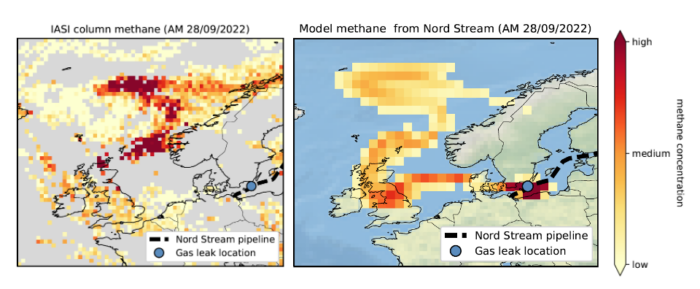
Observed (left) and simulated (right) methane from the Nord Stream gas leaks on September 28th 2022. Observations made by IASI instrument on-board EUMETSAT's MetOp-B.
References
Dowd, E., C. Wilson, M.P. Chipperfield, E. Gloor, A. Manning and R. Doherty,
Decreasing seasonal cycle amplitude of methane in the northern high latitudes being driven by lower latitude changes in emissions and transport, Atmos. Chem. Phys., 23, 7363-7382, doi:10.5194/acp-23-7363-2023, 2023.
Dowd, E., A.J. Manning, B. Orth-Lashley, M. Girard, J. France, R.E. Fisher, D. Lowry, M. Lanoisellé, J.R. Pitt, K.M. Stanley, S. O'Doherty, D. Young, G. Thistlethwaite, M.P. Chipperfield, E. Gloor and C. Wilson, First validation of high-resolution satellite-derived methane emissions from an active gas leak in the UK, Atmos. Meas. Tech., 17, 1599-1615, doi:10.5194/amt-17-1599-2024, 2024.
McNorton, J., M.P. Chipperfield, M. Gloor, C. Wilson, W. Feng, G.D. Hayman, M. Rigby, P.B. Krummel, S. O'Doherty, R.G. Prinn, R.F. Weiss, D. Young, E. Dlugokencky and S. A. Montzka, Role of OH variability in the stalling of the global atmospheric CH4 growth rate from 1999 to 2006, Atmos. Chem. Phys., 16, 7943-7956, doi:10.5194/acp-16-7943-2016, 2016.
McNorton, J., E. Gloor, C. Wilson, G.D. Hayman, N. Gedney, E. Comyn-Platt, T. Marthews, R.J. Parker, H. Boesch and M.P. Chipperfield, Role of regional wetland emissions in atmospheric methane variability, Geophys. Res. Lett., 43, 11,433-11,444, doi:10.1002/2016GL070649, 2016.
McNorton, J., C. Wilson, M. Gloor, R.J. Parker, H. Boesch, W. Feng, R. Hossaini, and M.P. Chipperfield, Attribution of recent increases in atmospheric methane through 3-D inverse modelling, Atmos. Chem. Phys., 18, 18149-18168, doi:10.5194/acp-18-18149-2018, 2018.
Parker, R.J., H. Boesch, J. McNorton, E. Comyn-Platt, M. Gloor, C. Wilson, M.P. Chipperfield, G.D. Hayman and A.A. Bloom, Evaluating year-to-year anomalies in tropical wetland methane emissions using satellite CH4 observations, Remote Sensing of Environment, 211, 261-275, doi.org/10.1016/j.rse.2018.02.011, 2018.
Parker, R., C. Wilson, A.A. Bloom, E. Comyn-Platt, G. Hayman, J. McNorton, H. Boesch, and M.P. Chipperfield, Exploring constraints on a wetland methane emission ensemble (WetCHARTs) using GOSAT satellite observations, Biogeosciences, 17, 5669-5691, doi:10.5194/bg-17-5669-2020, 2020.
Parker, R., C. Wilson, E. Comyn-Platt, G. Hayman, T.R. Marthews, A.A. Bloom, M.F. Lunt, N. Gedney, S.J. Dadson, J. McNorton, N. Humpage, H. Boesch, M.P. Chipperfield, P.I. Palmer and D. Yamazaki, Evaluation of wetland CH4 in the Joint UK Land Environment Simulator (JULES) land surface model using satellite observations, Biogeosciences, 19, 5779-5805, doi:10.5194/bg-19-5779-2022, 2022.
Wilson, C.J., M. Gloor, L.V. Gatti, J.B. Miller, A.A. Bloom, S.A. Monks, L. Basso and M.P. Chipperfield, Contribution of regional sources to atmospheric methane over the Amazon Basin in 2010 and 2011, Global Biogeochemical Cycles, 30, 400-420, doi:10.1002/2015GB005300, 2016.
Wilson, C., M.P. Chipperfield, M. Gloor, R.J. Parker, H. Boesch, J. McNorton, L.V. Gatti, J.B. Miller, L.S. Basso and S.A. Monks, Large and increasing methane emissions from Eastern Amazonia derived from satellite data, 2010-2018, Atmos. Chem. Phys., 21, 10643-10669, doi:10.5194/acp-21-10643-2021, 2021.
Wilson, C., B.J. Kerridge, R. Siddans, D.P. Moore, L.J. Ventress, E. Dowd, W. Feng, M.P. Chipperfield and J.J. Remedios, Quantifying large methane emissions from the Nord Stream pipeline gas leak of September 2022 using IASI satellite observations and inverse modelling, Atmos. Chem. Phys., 24, 10639-10653, doi:10.5194/acp-24-10639-2024, 2024.