
Short-Lived Chlorine and Bromine
It is now realised that very short-lived (VSL) chlorine- and bromine-containing halocarbons can have substantial impacts on the stratospheric ozone layer. These are species with an overall tropospheric lifetime of 6 months or less. This distinguishes them from the long-lived halocarbons such as CFCs, HCFCs etc. which are controlled by the Montreal Protocol. The most important source of VSL bromine is from natural emissions while VSL chlorine is mainly of anthropogenic origin.
Our group has been at the forefront over the past 15 years or so of establishing the importance of VSL bromine and chlorine for the ozone layer. This work spans the halocarbon budgets and impact on ozone. Some examples are given here.
Quantification of stratospheric bromine
Through detailed comparisons of the TOMCAT/SLIMCAT model with a range of observations we pioneered approaches to extract chemical budgets from photochemical comparisons. Through comparisons with balloons and aircraft (e.g. Harder et al., 2000; Pfeilsticker et al., 2000) we could help show that important (~25%) contribution of VSLS to total stratospheric bromine. These model-balloon comparisons (combining balloon radiances with chemical modelling to account for diurnal and other variations) also produced the first profile observation of BrO in the troposphere (Fitzenberger et al., 2000).
Natural Bromine
VSL bromine reaches the stratosphere through the natural emission of species such as bromoform (CHBr3) and dibromomethane (CH2Br2) (and degradation products). We developed chemical schemes of how to treat these compounds within a 3-D model framework (e.g. Hossaini et al., 2013) which are now largely followed in the community.
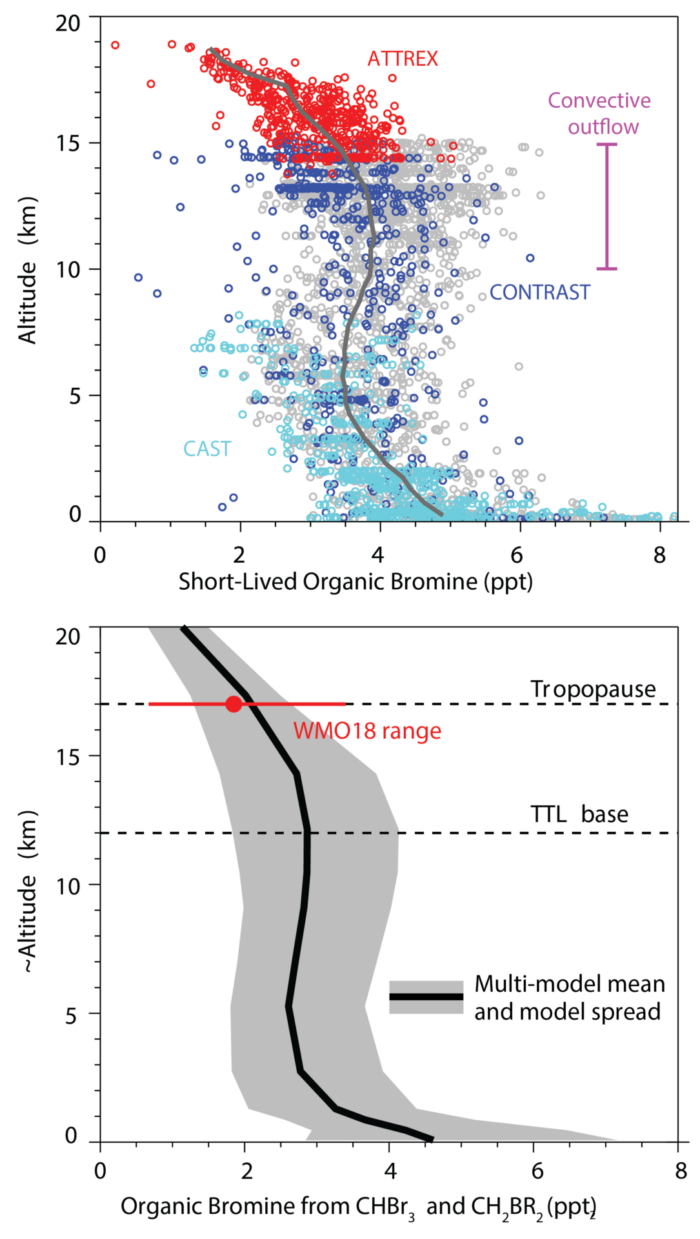
Top panel: Vertical profile of total organic bromine (ppt Br) from brominated VSL source gases (CHBr3, CH2Br2, CHBr2Cl, CH2BrCl, and CHBrCl2) observed during 2014 CAST, CONTRAST, and ATTREX missions over the Tropical Western Pacific. Bottom panel: Organic bromine from the two main source gases CHBr3 and CH2Br2 (ppt Br) from the TransCom-VSLS model intercomparison. The multi-model mean (black line) and model spread (gray shading) are shown, along with the best estimate (red circle) and range (red line) from the 2018 Assessment. Figure 1-10 from WMO/UNEP (2018) and modified from Hossaini et al.
Anthropogenic Cl
In contrast to bromine, the main chlorinated VSL of importance for the ozone layer are anthropogenic. The most notable of these is dichloromethane (CH2Cl2) whose atmospheric abundance has shown a strong upward trend in recent years (Hossaini et al., 2017). This work, and other studies, has brought the topic of VSL chlorine to the attention of the Parties to the Montreal Protocol. Ongoing emissions of VSL chlorine could delay recovery of the ozone layer and so there is interest in limiting this offset to the effective controls on long-lived chlorine. Moreover we showed that, through ozone depletion in the lower stratosphere, these VSLS can exert a disproportionately large climate impact Hossaini et al. (2015a).
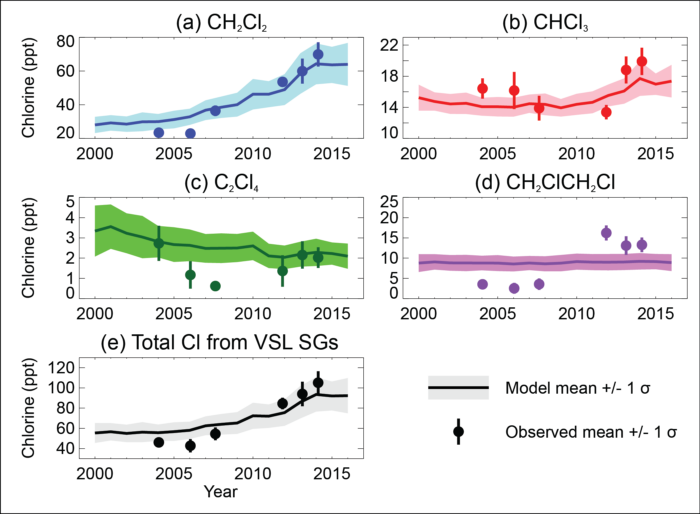
Modelled and observed stratospheric chlorine source gas injection (ppt Cl) for various VSLS evaluated at the tropical tropopause from (a) CH2Cl2, (b) CHCl3, (c) C2Cl4, (d) CH2ClCH2Cl, and (e) total. Figure 1-9 from WMO/UNEP (2018) and an update of Hossaini et al. (2015b).
TOMCAT References
Claxton, T., R. Hossaini, O. Wild, M.P. Chipperfield and C. Wilson, On the regional and seasonal ozone depletion potential of chlorinated very short-lived substances, Geophys. Res. Lett., 46, 5489-5498, doi:10.1029/2018GL081455, 2019.
Fitzenberger, R., H. Bosch, C. Camy-Peyret, M.P. Chipperfield, H. Harder, U. Platt, B.-M. Sinnhuber, T. Wagner and K. Pfeilsticker, First profile measurements of tropospheric BrO, Geophys. Res. Lett., 27, 2921-2934, doi:10.1029/2000GL011531, 2000.
Harder, H., H. Boesch, C. Camy-Peyret, M.P. Chipperfield, R. Fitzenberger, S. Payan, D. Perner, U. Platt, B.-M. Sinnhuber and K. Pfeilsticker, Comparison of measured and modeled stratospheric BrO: Implications for the total amount of stratospheric bromine, Geophys. Res. Lett., 27, 3695-3698, doi:10.1029/1999GL011215, 2000.
Harrison, J., M.P. Chipperfield, R. Hossaini, C.D. Boone, S. Dhomse, W. Feng and P.F. Bernath, Phosgene in the upper troposphere and lower stratosphere: a marker for product gas injection due to chlorine-containing very short-lived substances, Geophys. Res. Lett., 46, 1032-1039, doi:10.1029/2018GL079784, 2018.
Hossaini, R., H. Mantle, M.P. Chipperfield, S.A. Montzka, P. Hamer, F. Ziska, B. Quack, K. Krueger, S. Tegtmeier, E. Atlas, S. Sala, A. Engel, H. Boenisch, T. Keber, D. Oram, G. Mills, C. Ordonez, A. Saiz-Lopez, N. Warwick, Q. Liang, W. Feng, F. Moore, B.R. Miller, V. Marecal, N.A.D. Richards, M. Dorf and K. Pfeilsticker, Evaluating global emission inventories of biogenic bromocarbons, Atmos. Chem. Phys., 13, 11819-11838, doi:10.5194/acp-13-11819-2013, 2013.
Hossaini, R., M.P. Chipperfield, S.A. Montzka, A. Rap, S. Dhomse and W. Feng, Efficiency of short-lived halogens at influencing climate through depletion of stratospheric ozone, Nature Geoscience, 8, 186-190, doi:10.1038/ngeo2363, 2015a.
Hossaini, R., M.P. Chipperfield, A. Saiz-Lopez, J. Harrison, R. von Glasow, R. Sommariva, E. Atlas, M. Navarro, S.A. Montzka, W. Feng, S. Dhomse, C. Harth, J. Muhle, C. Lunder, S. O'Doherty, D. Young, S. Reimann, M. Vollmer, P. Krummel, and P. Bernath, Growth in stratospheric chlorine from short-lived chemicals not controlled by the Montreal Protocol, Geophys. Res. Lett., 42, 4573-4580, doi:10.1002/2015GL063783, 2015b.
Hossaini, R., M.P. Chipperfield, S.A. Montzka, A.A. Leeson, S.S. Dhomse, and J.A. Pyle, The increasing threat to stratospheric ozone from dichloromethane, Nature Communications, 8, 15962, doi:10.1038/ncomms15962, 2017.
Pfeilsticker, K., W.T. Sturges, H. Boesch, C. Camy-Peyret, M.P. Chipperfield, A. Engel, R. Fitzenberger, M. Mueller, S. Payan and B.-M. Sinnhuber, Lower stratospheric organic and inorganic bromine budget for the Arctic winter 1998/99, Geophys. Res. Lett., 27, 3305-3308, doi:10.1029/2000GL011650, 2000.